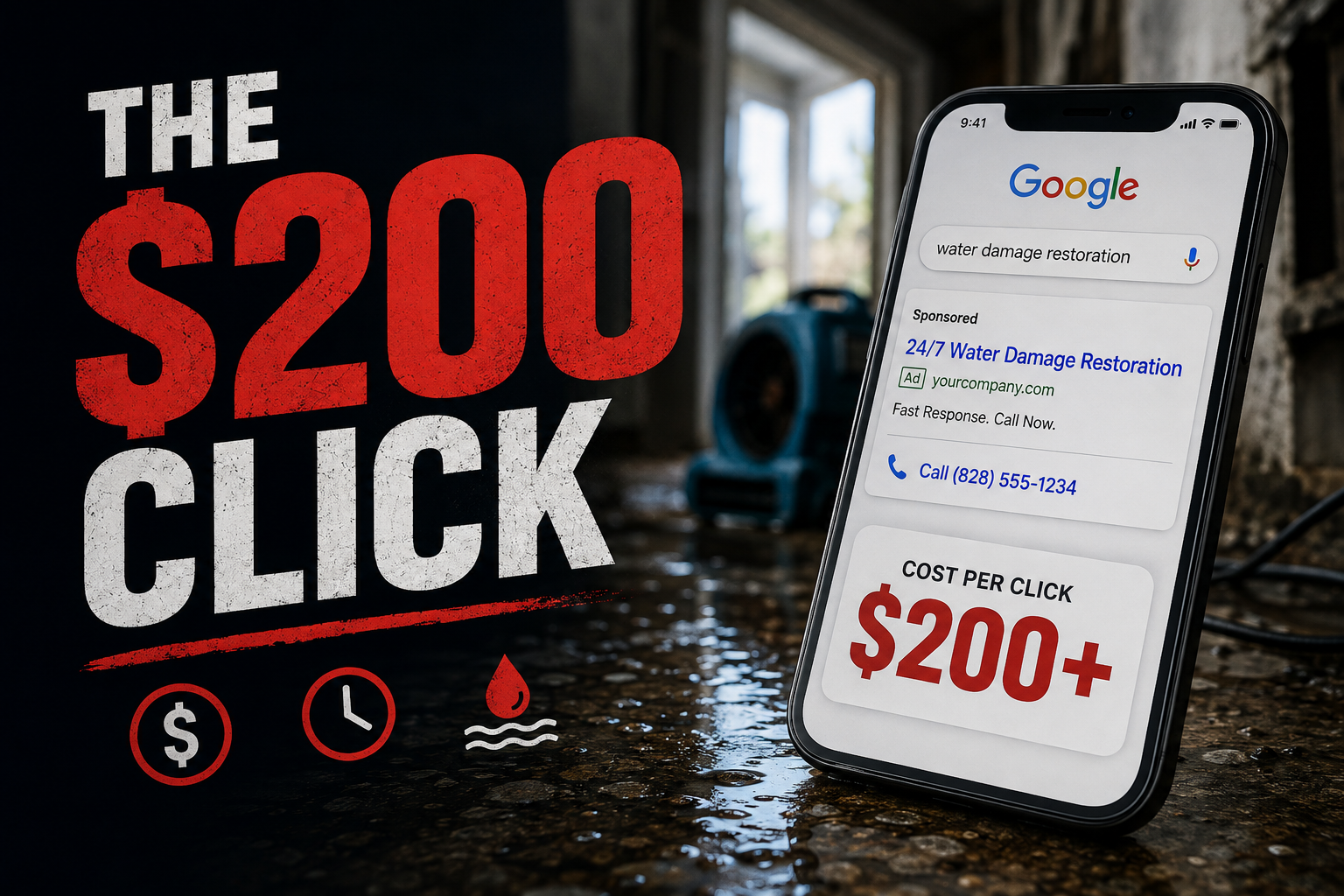
I’ve watched a restoration company pay north of $200 for a single click in urban New York.
The instinct is to call that broken. It isn’t — at least not automatically. But whether it’s rational depends entirely on what’s waiting on the other end of that click, and most restoration accounts I audit have never done that math. They’re bidding as if every water job is worth the same. It isn’t, and that gap is where the money goes.
Restoration is the most counterintuitive vertical I work in. Almost everything that’s true about PPC in home services generally is either wrong here or inverted. Here’s what I’ve learned running these accounts across Texas, the Carolinas, New England, and the Midwest.
Table of Contents
Demand isn’t Discovered. It’s Triggered.
Nobody researches water mitigation in advance. Nobody bookmarks a restoration company for later. A pipe bursts at 2am. Someone searches once, calls the first two or three results, and hires whoever answers and can be there fastest. The entire buying cycle is under an hour. That single fact dismantles the standard playbook. There’s no consideration window to nurture. No top-of-funnel to warm. No content sequence that meets them earlier in their journey, because there is no earlier — there’s a spike, a scramble, and a decision. Which means you’re not competing for attention. You’re competing for the ninety seconds after the trigger.Which Inverts the Usual Channel Advice
In most trades, the advice runs: invest in organic for the long game, use paid to fill gaps while you build. Cheap durable traffic eventually replaces expensive rented traffic. In restoration, that logic collapses. The searcher isn’t scrolling to your beautifully optimized page — they’re calling before they reach the fold. Organic rankings you can’t monetize inside a ninety-second window aren’t an asset, they’re a vanity metric. For franchisees, it’s worse. Across the franchise systems I’ve worked in, the location site is usually a corporate template with a locked page structure, minimal control over content, and a domain shared with hundreds of other locations competing for the same terms. You’re not losing the SEO game. You’re not permitted to play it. Industry standard advice would tell a business in this position to build organic authority first and treat paid as a temporary bridge. For a franchisee on a template site, that sequencing is close to backwards. Paid is not the stopgap. It’s frequently the only channel that can reach the buyer at the moment the buyer exists. And the budget logic flips too. The usual counsel to a small budget is to stay out of expensive auctions. Here, a small budget is an argument for concentrated paid spend, because a limited amount of money aimed precisely at the moment of need will beat the same money spread across channels that can’t close the gap in time.National Benchmarks in this Vertical are Worthless
I’ve seen emergency-intent water damage CPCs run over $200 in urban New York. Texas metros generally land in the $50–100 range depending on the market. Charlotte tends to run friendlier — $40–80. Same service line. Same intent. Four to five times the cost depending on where you’re standing. So when someone quotes you a national restoration benchmark, they’re either selling something or they’ve never run these accounts. There is no meaningful national number. There are markets, and they behave differently enough that a strategy built for one will fail in another. The conversion math is also rougher than the CPC suggests. That homeowner is calling three companies. Two of them are paying full freight for a click that was never going to convert. You are not paying per lead, you’re paying for entry into a race you’ll frequently lose.Water is the Only Line You can Actually Forecast
Fire is largely stochastic outside wildfire regions. Mold is a lagging discovery event — it surfaces weeks or months after the water intrusion that caused it. Water and storm damage, though, are genuinely predictable in aggregate. Weather bands. Hurricane season. Freeze events. Hail corridors. You know roughly when demand will spike, and often within a few days of when. The theoretically correct response is event-driven spend: surge hard into the trigger window, pull back during dry stretches. In practice, most franchisees are on a flat monthly budget they can’t flex on short notice. So the workable version is a reserve. I hold back a portion of monthly spend specifically for push windows rather than letting the account run flat and even through periods where demand simply isn’t there. It’s less elegant than true event-driven bidding. It’s achievable, which matters more.Not Every Job Clears the Math
This is the part most accounts get wrong. A post-hurricane structural water remediation and a small kitchen fire cleanup arrive through overlapping keywords and differ by an order of magnitude in job value. Mold discovered inside a wall cavity is a different economic event than a contained appliance leak. If you’re bidding the same on all of it, you’ve built an account where your most expensive clicks subsidize your least profitable work. Some service lines don’t clear the math at $200 a click. Occasionally an entire market doesn’t. I’ve told clients not to run ads — not to run less, not to restructure, but to stop — because the job values in their mix couldn’t support the auction they were entering. That’s an uncomfortable conversation for an agency to initiate. It’s also the difference between a strategist and a vendor. My job is to bring clients leads that turn into profitable work. It is not to spend whatever budget I’m handed on whatever the client asks for.Intake is the Highest-Leverage Variable in the Account
At $200 a click, a missed call isn’t a lost lead. It’s a lost job with the media cost already sunk. This is where a lot of restoration accounts quietly hemorrhage money. The campaign is fine. The targeting is fine. Nobody picks up at 2am, and the emergency goes to whoever does. You have effectively paid a premium to route a customer to your competitor. Before we scale spend on a restoration account, I want to know what happens to a call at three in the morning on a Sunday. If the honest answer is voicemail, we fix that first — which is a large part of why we put AI answering infrastructure in place for clients in this vertical. Media spend without intake capacity isn’t a growth strategy, it’s a donation. Local Services Ads sit adjacent to this and get treated as a channel to optimize. They aren’t. LSA performance is downstream of reputation operations: review velocity — not just total count — consistent positive sentiment, a complete and current profile, fresh imagery. None of that is media work. It’s operational discipline, and it’s the first thing that slips when a franchise owner is genuinely busy with jobs. Hiring someone to own it is out of reach for most small operators, so it lands on the owner, so it doesn’t happen. It’s the least glamorous lever in the account and one of the highest-return, because strong LSA performance directly buys down the effective cost of an auction where you’re otherwise paying $200 to get in line.What this Actually Means
Restoration rewards operators who understand that the strategy is inverted, not just expensive. Paid isn’t the supplement — it’s often the only channel that reaches the buyer in time. Benchmarks don’t travel between markets. Predictable demand deserves reserved budget rather than flat spend. Job value has to drive bidding, or your account funds your worst work. And none of it matters if the phone doesn’t get answered. The agencies that struggle here are the ones applying a generic home services playbook to a trade that doesn’t behave like home services. The ones that win are willing to say the uncomfortable thing — including, sometimes, that the ads shouldn’t run at all.Your Marketing Should Generate More Than Clicks. It Should Generate Growth.
Whether you’re in restoration, HVAC, roofing, construction, or another service industry, the goal is the same: turn marketing investment into real leads, customers, and revenue.
828 Marketing and Web combines proven lead-generation strategies, smarter data, and practical AI to build growth systems around what actually moves your business forward. No blind marketing. No chasing vanity metrics. Just a clear strategy built around measurable results.
Ready to turn your marketing into a system that generates real opportunities?
Get Leads Today