I audited an HVAC company this summer that had five different phone numbers floating around online, three different versions of their weekend hours, and a 4-star review from a customer of twenty years that said, word for word, “It’s challenging to get someone to answer the phone.”
Their technicians were praised by name in review after review. Their office was where the leads went to die.
That company had no chatbot at all. But if they had bought the kind most businesses buy, the cheap one you turn on in an afternoon, it would not have helped them. It would have been one more thing on the website that could not answer the question the customer was actually asking.
Here’s the difference between an out-of-the-box chatbot and a custom AI chatbot built for a home service business, and why the gap between them is measured in booked jobs.
Table of Contents
What Is an Out-of-the-Box Chatbot?
You have seen it. A little bubble in the corner of a website. You type “do you service my area?” and it says “Thanks for reaching out! Someone will get back to you soon.” Or it hands you a menu of four buttons, none of which is the thing you needed.
These are out-of-the-box chatbots. They come pre-built. You paste a line of code on your site, maybe type in your business hours and a phone number, and you are done. They are cheap and fast to set up, and that is the whole pitch.
The problem is that they know nothing about your business. They know your hours, if you remembered to enter them. They don’t know what a service call costs. They don’t know which towns you cover. They don’t know that when someone types “my furnace gave out,” that is a person standing in a cold house who needs a truck, not a person browsing.
So they do what anything does when it doesn’t know the answer. They stall. “Great question! Leave your email and we’ll follow up.”
Why Generic Chatbots Lose Home Service Leads
The customer leaves. That’s what goes wrong.
Think about what the person on the other end wants. They have a problem, usually right now. They want three things: is this the right company, what is it going to cost me to find out what’s wrong, and how fast can someone get here. If the chatbot cannot answer at least the first two, the customer closes the window and calls the next name on Google.
And most home service companies never see that happen. The chatbot vendor’s dashboard says “47 conversations this month.” What it does not say is that 40 of them ended after two messages because the bot had nothing to offer.
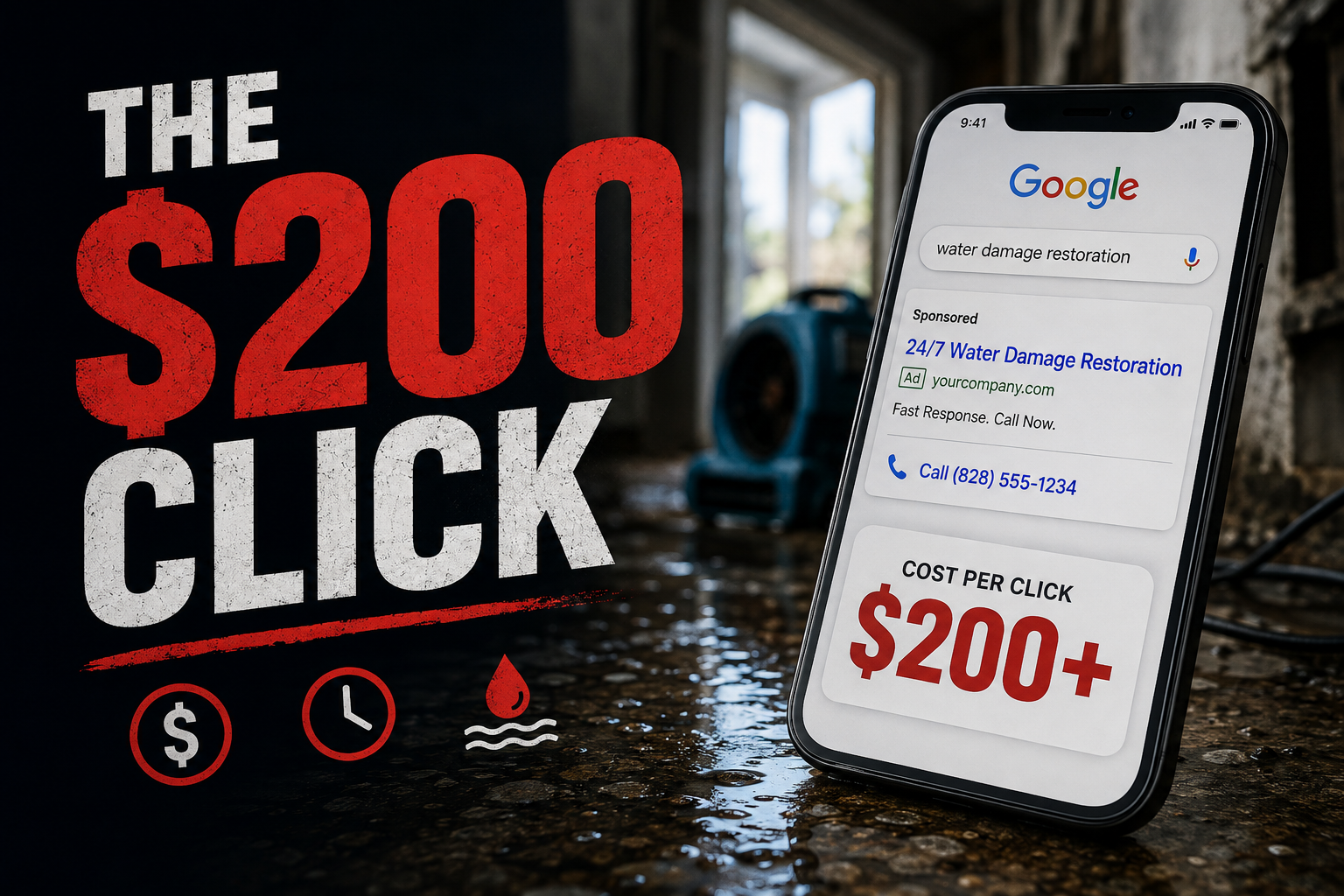
The phone is worse. After hours, most small businesses roll to voicemail or a generic answering service that takes a name and number and nothing else. The office calls back the next morning, blind, to a customer who already hired someone at 9pm. In a trade like restoration, where you may have paid $200 for the click that produced that call, a missed call is a lost job with the ad money already spent.
This is not a technology problem. It is a knowledge problem. The tool did not know enough to be useful.
What a Custom AI Chatbot Is Built On: Research First
When we build a custom AI chatbot for a client, the first thing we do is not build anything. We research.
We read every page of the client’s website and every version of their hours and phone numbers, because there is almost always more than one. We read their reviews, all of the negative ones and at least the last year and a half of the rest. We look at what customers praise, what they complain about, and which employees they mention by name.
Most important, we write down the exact words customers use when something is broken. Not the words the company uses on its website. The company writes “AC not cooling efficiently.” The customer writes “it died,” “it gave out,” “it went out on the hottest week of the year.” The AI has to understand the customer’s language, not the marketing department’s.
Then we go to the client with a short list of questions we could not answer ourselves. What happens today when someone calls after close. What counts as a real emergency to you. What it costs to send a technician out, and whether that price changes at night or for members. What you never want an automated system to promise on your behalf.
That last one matters more than people expect. Most owners say “never promise anything.” When we push for specifics, the real list comes out: never quote a repair price before a tech has looked, never promise an arrival time, never say whether something is covered under warranty. Those become hard rules.
By the end of research we know the business about as well as the person who answers their phone. That is the point.
Building the Knowledge Base That Powers the AI
Everything from research goes into what we call the brain. It’s a written knowledge base, in plain language, that holds every fact the AI assistant is allowed to use.
Who the company is and when it was founded. Every town it serves, by name. Every service, residential and commercial. Every price the owner has approved for the assistant to say out loud, spelled out for each situation: member versus non-member, business hours versus after hours. What the maintenance plan costs and what it includes. Which lenders handle financing. What counts as an emergency, with examples, and what happens after hours. The safety rules for the trade, like “if you smell gas, leave the house and call 911 before you call us.”
And the customer language section, straight from the reviews, uncleaned.
Just as important is what the brain does not contain. If a fact was not confirmed by research or by the client in writing, it is not in there. The assistant is not allowed to fill gaps with something that sounds reasonable. If it does not know, it says so and takes the customer’s information for the office.
On top of the brain sits a set of instructions for how to behave. Talk in short plain sentences. Ask one question at a time. Answer the question first. Do not sound like a brochure. You are not a salesperson. If someone is frustrated, acknowledge it once, take their details, and get them to a person. Never argue.
Then the capture sequence, which is the whole reason this exists: name, phone number read back to confirm, service address, and the problem in the customer’s own words. Then a confirm-back so the customer knows they were heard: “Got it, Karen. No heat since last night, and you’re at 412 Sycamore. The office will call you to get that scheduled.”
We test it against the traps before it goes live. Ask it for a repair price. Ask it to guarantee a Tuesday 9am slot. Name a competitor’s brand and ask if it can be serviced. Ask if the repair is under warranty. Demand a human. Give an address outside the service area. An out-of-the-box chatbot fails most of these. Ours has to pass all of them.
AI Voice Agent vs Website Chatbot: One Brain, Two Channels
Here is where it gets useful. That same brain powers two different assistants.
The first is the website chatbot. A visitor opens the bubble, asks a real question, and gets a real answer, with prices and service areas and links to the right page. It collects their details in a normal back-and-forth, not a form, and tells them the office will call.
The second is an AI voice agent that answers the phone. Same knowledge, same rules, different delivery. It sounds like a person. It talks in short sentences, waits for the caller to finish, uses their first name once it has it, and says prices as words the way a human would. Most callers assume they are talking to someone at the front desk. If they ask, it tells them it is an automated assistant. It never pretends.
The voice agent has its own rules the chatbot does not need. It never reads a phone number to someone who is already on the phone. It never promises a technician will arrive at a certain time, because the office decides that. If there is a true after-hours emergency and the client has an on-call process, it routes the call there. If a robocall comes in, it hangs up.
Same facts, same guardrails, both channels. The customer gets a consistent answer whether they typed it or said it at 2am. This is the difference between an AI answering service that takes a message and one that actually answers.
Unified Inbox and Lead Notifications: Nothing Gets Lost
None of this matters if the lead goes nowhere.
Every conversation, chat or phone, lands in one unified inbox the office can see. Every lead the assistant captures becomes a contact record with the name, phone, address, and the problem in the customer’s own words. The moment that record is created, the office gets an email with all of it. Not a transcript to dig through. The five things they need to call back and book the job.
So the morning after a 9pm “my furnace gave out” call, the office is not calling back blind. They are calling Karen at 412 Sycamore who has had no heat since last night, and they already know it.
We don’t consider a build done when the software says it’s done. We consider it done when a real conversation on the live site produces a real notification email in the client’s inbox with every field filled in. Until that email lands, nothing is finished.
What Changes for a Home Service Business
Go back to that HVAC company with five phone numbers and the customer who can’t get anyone to pick up.
With this in place, the 9pm caller gets a calm voice that knows the service area, knows what an after-hours visit costs, takes the address, and tells them the office will call first thing. The website visitor who wants to know if the estimate is free gets a straight answer instead of a “we’ll follow up.” Both of them are in the inbox before anyone at the company wakes up, with their problem written in their own words.
The technicians everyone loves in the reviews are still the technicians. The difference is the front door is finally open when people knock.
That is what “custom AI Chatbot” means. Not a different color bubble. A system that knows your business well enough to answer for it, built from research on your customers, with rules your owner set, connected so nothing gets lost. The out-of-the-box version skips every one of those steps, and that is exactly where the leads fall out. It’s the same reason a website stops generating leads: the traffic is there, and the thing that is supposed to catch it can’t.
Frequently Asked Questions
What is the difference between a custom AI chatbot and an out-of-the-box chatbot?
An out-of-the-box chatbot is pre-built and knows only what you type into a settings screen, usually hours and a phone number. A custom AI chatbot is built on a knowledge base written from research on your business and your customers: services, service area, approved prices, emergency rules, and the words customers actually use. One stalls when it hits a real question. The other answers it.
Do AI voice agents sound like real people?
Yes. A well-built AI voice agent talks in short sentences, waits for the caller to finish, and says prices as words. Most callers assume they are talking to the front desk. If a caller asks, the agent says it is an automated assistant. It should never pretend to be human.
Can an AI chatbot book appointments for a home service business?
It can, if the owner wants it to. Most of the businesses we work with prefer the assistant to collect the name, phone, address, and problem, then tell the customer the office will call to schedule. The office keeps control of the calendar and the customer still gets an answer at 2am instead of voicemail.
How does the office know when the AI captures a lead?
Every chat and call lands in one unified inbox. When the assistant captures a lead, a contact record is created and the office gets an email right away with the name, phone, address, and the customer’s description of the problem.
Is an AI answering service worth it for a small HVAC or plumbing company?
If you run paid ads or Local Services Ads and calls go to voicemail after hours, you are paying for leads that go to whoever picks up. An AI answering service that actually answers questions and captures details turns those calls into next-morning callbacks with the problem already known. Whether it is worth it depends on how many calls you miss now, which is the first thing we look at.
Your Marketing Should Generate More Than Clicks. It Should Generate Growth.
Whether you’re in HVAC, restoration, roofing, construction, or another service industry, the goal is the same: turn marketing investment into real leads, customers, and revenue.
828 Marketing and Web combines proven lead-generation strategies, smarter data, and practical AI like SolomonX to build growth systems around what actually moves your business forward. No blind marketing. No chasing vanity metrics. Just a clear strategy built around measurable results.
Ready to turn your marketing into a system that generates real opportunities?