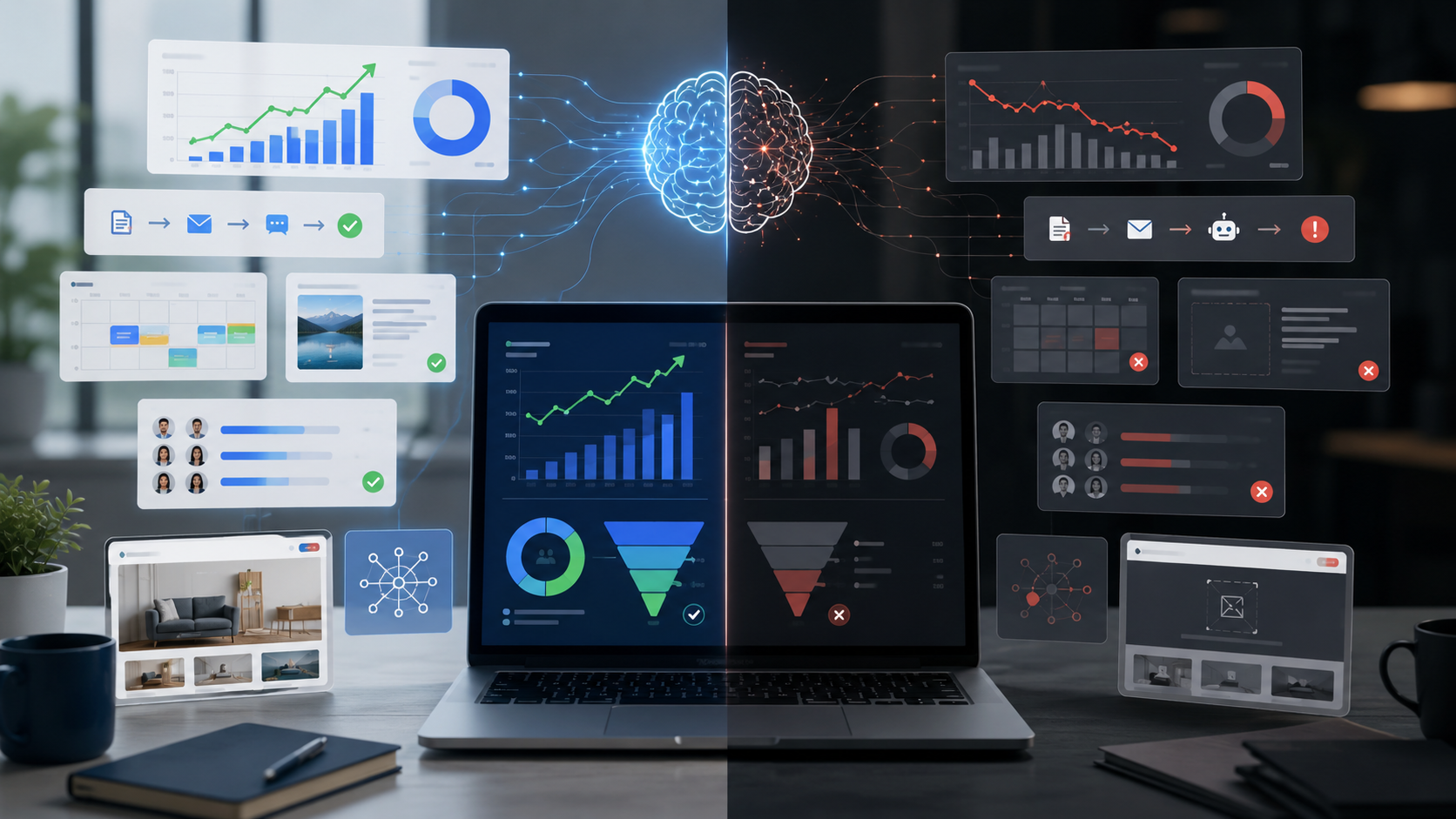
AI is going to change marketing. It already has.
It can write content, build pages, create ad variations, summarize reports, review websites, analyze calls, draft emails, generate social posts, and support customer follow-up.
That is why business owners are paying attention. If you run a service business, you have probably seen the pitch already.
“Let AI handle your marketing.”
“Let AI build your website.”
“Let AI write your content.”
“Let AI run your campaigns.”
“Let AI replace your agency.”
Table of Contents
- Better-Looking Is Not the Same as Better-Performing
- AI Does Not Automatically Know What Is Working
- The Local SEO Example
- The Same Risk Applies Beyond Websites
- AI Can Help You Move Faster in the Wrong Direction
- AI Should Automate Execution, Not Accountability
- This Is Where Marketing Agencies Are Going to Split
- Why This Matters for Service Businesses
- What Business Owners Should Ask Before Using AI for Marketing
- The Right Way to Use AI in Marketing
- The Future Is Not AI vs. Advisors
- The Practical Takeaway
- Want to Know Where Your Growth System May Be Leaking?
Some of those tools may actually be useful. Some could become very useful. We have been using AI every day at 828 for years now. We use it for research, strategy, reporting, content planning, SEO audits, campaign planning, sales support, proposal review, and internal process improvement. We also have SolomonX, our proprietary AI framework, to help identify where businesses are losing leads, booked jobs, reviews, repeat revenue, and growth opportunities.
This is not an anti-AI article. It is the opposite. AI is one of the most important tools we have ever seen for improving how marketing gets done. But that doesn’t mean a business should hand its growth system over to an AI tool and hope it understands what matters and what doesn’t. Before you let AI rebuild your marketing, you need to know what you might be deleting. Because the biggest risk is not that AI creates something ugly.
The bigger risk is that AI creates something clean, fast, and convincing that quietly removes the things already helping your business generate leads.
Better-Looking Is Not the Same as Better-Performing
This is one of the easiest mistakes to make. A business owner looks at the current website and thinks, “This looks outdated.” Then an AI tool creates a clean new version in minutes. The new site looks modern. It loads fast. The copy sounds polished. The layout feels simple. At first glance, it looks like progress. But a lead generation website is not just a design project, it is a business asset.
- Some pages may be ranking in Google.
- Some service pages may support paid ads.
- Some city pages may bring in calls from specific markets.
- Some blog posts may answer questions buyers are already searching.
- Some internal links may help Google understand what the company does.
- Some tracking scripts may connect forms, calls, ads, and reporting.
- Some older pages may not look impressive, but they may be doing real work.
If those pieces are removed during a rebuild, the new website may look better while performing worse. That is what many AI-first marketing tools will miss. They can improve the surface while damaging the system underneath.
AI Does Not Automatically Know What Is Working
AI can create output quickly.
But it does not automatically know your business.
It does not know which services produce the best margins.
It does not know which cities matter most.
It does not know which pages bring in qualified leads.
It does not know which calls became booked jobs.
It does not know which rankings took years to earn.
It does not know which landing pages support your ad campaigns.
It does not know which content helps customers trust you.
It does not know which parts of your current marketing are weak and which parts need to be protected.
Unless someone gives AI the right context, it is working from the surface. That is dangerous. Because marketing is full of things that do not look important until they are gone.
The Local SEO Example
This is especially important for home service companies. Local SEO is not built from one homepage and a few service descriptions.
For many service businesses, local visibility is built through a larger system:
- service pages
- city pages
- service area pages
- Google Business Profile optimization
- reviews
- internal links
- local content
- schema markup
- citations
- backlinks
- tracking
- consistent contact information
- clear service and location signals
An AI website builder may create a clean one-page website.
But what happens if it removes twenty service area pages?
What happens if it combines five profitable services into one short section?
What happens if it changes URLs without redirects?
What happens if it removes pages that ranked for searches like “roof repair near me,” “water damage restoration,” “AC repair,” or “landscaping company in [city]”?
What happens if it removes the structure that helped Google understand what you do and where you do it?
The damage may not show up on launch day.
The site may look better immediately.
But a few weeks or months later, calls may slow down. Rankings may drop. Organic traffic may fall. Paid ads may get more expensive because the landing pages are weaker.
Then the business has to figure out what happened.
That is when the fast rebuild becomes expensive.
The Same Risk Applies Beyond Websites
This is not just a website problem. AI tools are now being sold for SEO, paid ads, social media, email, lead follow-up, reporting, sales automation, customer service, and more. Again, many of these tools can be useful. But only when they are connected to strategy.
- An AI ads tool can build campaigns, but it may not understand which services are most profitable.
- An AI content tool can create blog posts, but it may not know which topics support the customer journey.
- An AI social tool can post regularly, but it may not say anything that builds trust.
- An AI chatbot can answer questions, but it may not know when a lead needs a real person.
- An AI email tool can automate follow-up, but it may not understand the timing, tone, or offer needed to move someone forward.
- An AI reporting tool can summarize numbers, but it may not know which numbers should change the next business decision.
This is the point owners need to understand. AI can perform tasks. But marketing is not just a collection of tasks. Marketing is a growth system. And a growth system needs strategy, judgment, measurement, and accountability.
AI Can Help You Move Faster in the Wrong Direction
AI is a force multiplier.
That means it can multiply good strategy.
It can also multiply bad strategy.
If your message is clear, AI can help create better content around it.
If your sales process is strong, AI can support better follow-up.
If your data is clean, AI can surface better insights.
If your offer is strong, AI can help test variations faster.
If your website structure is sound, AI can help improve and expand it.
But if the strategy is unclear, AI can create more noise.
If the wrong services are being promoted, AI can promote them faster.
If the website is rebuilt without understanding SEO, AI can remove valuable pages.
If the follow-up process is weak, AI can automate a weak process.
If the data is messy, AI can summarize the wrong story.
If nobody knows what is working, AI can help change things that should have been protected.
That is the danger of autonomous AI in marketing.
It does not always know when it is wrong.
And most business owners do not have time to inspect every decision it makes.
That is why we do not believe the future of marketing is fully automated decision-making.
We believe the future is AI-powered execution guided by experienced human advisors.
AI Should Automate Execution, Not Accountability
There is a big difference between automating execution and automating decisions. Execution is the work that needs to get done. Research, Drafting, summarizing, auditing, reporting, organizing, testing, monitoring, creating variations, finding patterns, building first drafts, or supporting workflows.
AI can help with all of that.
Accountability is different.
Accountability means someone understands the business goal.
Someone knows what should be protected.
Someone can interpret the data.
Someone can explain the tradeoffs.
Someone can prioritize the next step.
Someone can communicate clearly with the owner.
Someone is responsible when the results are not what they should be.
That part should not be handed to an unsupervised tool.
At 828, that is how we think about AI.
We are not trying to automate judgment out of the process.
We are trying to use AI to strengthen the judgment, speed, consistency, and execution of the people responsible for the process.
That is the difference.
AI can help us move faster.
But experienced strategists still need to decide where we are going.
This Is Where Marketing Agencies Are Going to Split
AI will change agencies too. Some agencies will simply say they “do AI.” That may mean they use AI to write faster blog posts, generate social captions, create reports, or build campaign ideas. That is fine, but it is not enough.
Other agencies will use AI as a cost-cutting tool and pass off more automated output as strategy.
- That will create problems.
- The better model is different.
- The better model is an operating system.
A real AI-powered marketing operating system should combine:
- business strategy
- lead generation frameworks
- human judgment
- client context
- campaign execution
- reporting
- AI-assisted analysis
- follow-up systems
- ongoing optimization
- clear accountability
That is what we are building around.
- Not AI as a gimmick.
- Not AI as a replacement for thinking.
- Not AI as a shortcut around strategy.
AI as a platform layer that helps an experienced marketing team deliver better advisory-led execution.
That is where SolomonX fits.
SolomonX is not meant to replace our team.
It is being built to strengthen our team’s ability to assess growth opportunities, identify where leads are being lost, support better decisions, and create more consistent advisory value for clients. The goal is not more marketing activity. The goal is clearer growth decisions and better execution.
Why This Matters for Service Businesses
Most service business owners do not want to manage marketing all day. They already have enough to do.
They are managing people, jobs, customers, operations, cash flow, equipment, schedules, estimates, vendors, and quality control.
They do not need another complicated software platform that creates more work for them.
They need clarity.
They need to know what is working.
They need to know what is changing.
They need to know where leads are being lost.
They need to know what should be fixed first.
They need to know whether marketing dollars are being used wisely.
They need a team that can think with them, advise them, and execute for them.
That is why advisor-led execution matters. It allows the business owner to stay focused on running the business while a dedicated growth partner helps lead the marketing system. AI should make that relationship stronger. It should help the marketing team analyze more, execute faster, communicate better, and identify opportunities sooner. But it should not leave the owner trying to manage a set of disconnected AI tools.
That is not freedom.
That is just a new kind of complexity.
What Business Owners Should Ask Before Using AI for Marketing
If you are considering an AI website builder, AI SEO tool, AI ad platform, AI social media system, AI chatbot, or AI marketing vendor, ask these questions first:
What is currently generating leads?
Which pages bring in traffic, calls, forms, or booked jobs?
Which services are most profitable?
Which markets matter most?
What rankings have we earned?
What content should be preserved?
What URLs need to stay the same or be redirected?
What tracking needs to remain in place?
What campaigns depend on current landing pages?
How will this affect our Google Business Profile, reviews, citations, and local visibility?
Who is reviewing the strategy before AI makes changes?
Who is accountable if leads drop?
Those questions matter because your marketing already has assets, systems, and history. Before you replace anything, you need to know what you are replacing.
The Right Way to Use AI in Marketing
The right answer is not to avoid AI.
That would be a mistake.
AI is going to be part of modern marketing.
The right answer is to use AI inside a clear growth strategy.
Start with the business.
What are you trying to grow?
Which customers do you want more of?
Which services matter most?
Where are leads being lost?
Where is follow-up breaking down?
Where is the customer confused?
What needs to be protected?
What needs to be improved?
Then use AI to help the right people do the right work faster and better.
That is very different from handing your marketing to a tool and hoping it understands your business.
The Future Is Not AI vs. Advisors
Some people talk as if the future is AI replacing agencies, consultants, and marketing teams. I do not think that is the right picture. The better picture is AI-supported expertise. AI will do more of the execution. Experienced advisors will interpret, prioritize, communicate, and make decisions.
AI will help surface patterns.
Advisors will decide what those patterns mean.
AI will help create drafts.
Advisors will decide what should be said.
AI will help monitor campaigns.
Advisors will decide what should change.
AI will help identify gaps.
Advisors will decide what matters most.
AI supports people.
It does not replace the need for judgment, context, and accountability.
At least not if growth is the objective.
The Practical Takeaway
Before you let AI rebuild your marketing, slow down long enough to take inventory. Your current marketing may have weak spots.
- It may need a better website.
- It may need better content.
- It may need better ads.
- It may need better follow-up.
- It may need AI.
But it may also have assets worth protecting.
A page that looks old may still rank. A blog post that seems basic may still bring in traffic. A city page may be helping you show up in a profitable market. A tracking setup may be helping you understand what is working. A landing page may be supporting a campaign that generates real jobs. Do not delete those things by accident. AI can absolutely help your business grow. But it needs strategy, context, and accountability. Because the goal is not simply to make marketing faster. The goal is to make marketing better.
Want to Know Where Your Growth System May Be Leaking?
If you are not sure what is working, what is missing, or where leads may be slipping away, start there before making major changes.
The SolomonX Growth Assessment was built to help service businesses identify gaps across their lead generation system, including visibility, messaging, website conversion, follow-up, reviews, and repeat revenue opportunities.
It is not a generic SEO scan.
It is a practical review of where your growth system may be leaking and where smarter strategy, better execution, and practical AI could help.
Before you rebuild the system, understand the system.